
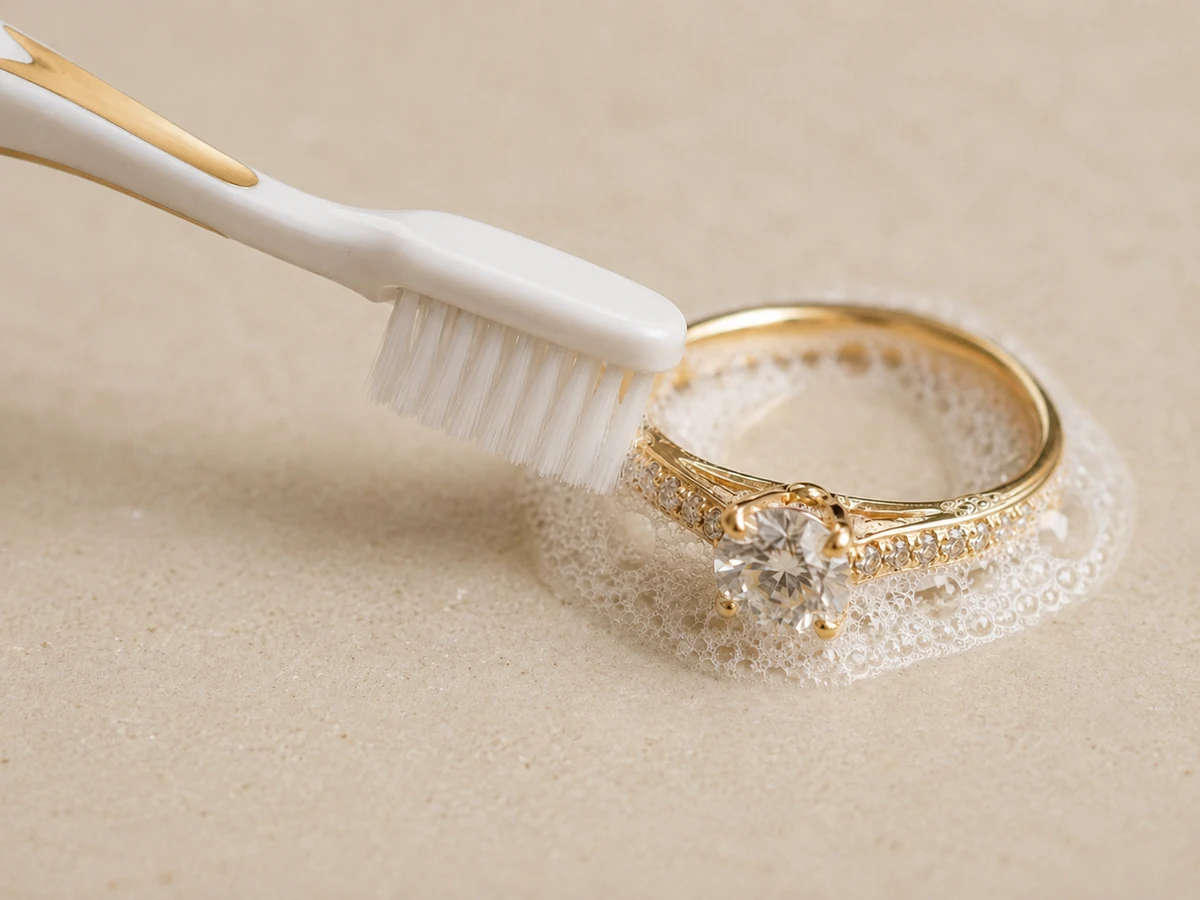
For routine cleaning of simple gold jewellery without sensitive stones lukewarm water, a small amount of mild soap and a soft brush are usually enough.
Recommended procedure
To answer the question of how to clean gold jewellery, you need not look far: the process is fairly simple even at home. Prepare a small bowl of lukewarm water. Add a few drops of mild liquid soap or a gentle washing-up liquid without abrasive particles or harsh additives.
Place the jewellery in the solution for approximately five to ten minutes. Longer soaking is usually unnecessary. Then clean it very gently with a soft brush, ideally a children's toothbrush with soft bristles labelled ultra-soft.
Pay particular attention to places where grease accumulates:
the inside of rings,
prostor pod kamenem,
around the claws,
chain links,
earring fastenings.
Then rinse the jewellery thoroughly in clean, lukewarm water and dry it with a soft microfibre cloth. Let it dry completely before storing.
Always close the drain when rinsing over a sink. It is safer to rinse jewellery over a bowl so it cannot fall down the drain.
1. Which products can be used on gold jewellery
The safest home option is lukewarm water and mild liquid soap. Strong chemicals are unnecessary for routine care.
Mild liquid soap
The soap must not contain abrasive particles, exfoliating ingredients or strong solvents. Just a few drops are enough. Too much can leave another film on the surface that needs thorough rinsing.
Mild washing-up liquid
You can use a small amount of an ordinary gentle product without bleaching agents. Rinse it thoroughly. This method is mainly suitable for simple gold jewellery and certain durable stones (diamond, moissanite)
Specialist gold cleaning solution
Products specifically intended for cleaning gold are available. Always read the instructions and check whether the product is also suitable for specific gemstones, the surface finish and the way they are set.
Labelling a product 'for jewellery' does not automatically mean it is safe for every kind of stone.
Soft brush
The brush must have very soft bristles. A brush that is too hard may damage polished surfaces, catch on delicate parts or put stress on stone settings.
Microfibre cloth
A soft cloth without coarse fibres is suitable for drying and removing fingerprints. There is no need to scrub the jewellery vigorously; a light wipe is enough.
Gold polishing cloth
A specialist polishing cloth can help restore smooth, polished surfaces. It must be intended specifically for gold.
Not suitable for:
matt finishes,
sandblasted surfaces,
rhodium-plated jewellery,
gold-plated jewellery,
blackened or otherwise surface-treated parts.
Polishing cloths may contain a mild abrasive. Frequent or forceful use can therefore gradually alter the surface.
2. What never to use on gold jewellery
The internet offers many home-cleaning guides recommending toothpaste, bicarbonate of soda, vinegar or other everyday products. For valuable gold jewellery, however, these methods can damage the surface or the set stones.
Toothpaste
Toothpaste contains abrasive particles intended to clean teeth mechanically. It can leave fine scratches on polished gold. Repeated use may make jewellery appear duller and lose its even shine.
Bicarbonate of soda and cleaning powders
Bicarbonate of soda is often recommended as a universal cleaning product. As a paste or powder, however, it can be abrasive. It is particularly risky for delicate finishes, gold-plated jewellery and pieces set with gemstones.
Vinegar and lemon juice
Acidic products are not a suitable universal method for cleaning jewellery. They may react with components of gold alloys, soldered joints or sensitive stones. They can also damage organic materials such as pearls.
Chlorine and bleach
Chlorine-based chemicals can adversely affect the metals added to gold alloys. Concentrated cleaning products, pool chemicals and bleach are particularly risky.
It is therefore advisable to remove before swimming in a pool, using chlorine-based products or intensive cleaning.
Scourers, rough sponges and hard brushes
These tools can significantly scratch gold surfaces. The damage cannot then be removed by ordinary home cleaning and may require professional repolishing.
Boiling water
Very hot or boiling water can cause problems for jewellery with sensitive stones, fracture fillings, glued components or already weakened settings. Sudden temperature changes can damage some minerals.
Unverified chemical solutions
We do not recommend ammonia, alcohol, acetone or other strong chemicals without precise knowledge of the materials in your jewellery. Some may be suitable for professional cleaning of specific pieces, but they are not a universal home-cleaning solution.
Ultrazvuk
Our experience as jewellers tells us that, before ultrasonic cleaning, the setting, the construction of the piece and the properties of its stones must be checked. At home, owners generally cannot carry out this assessment reliably. We therefore do not recommend ultrasonic cleaning at home. If you choose not to follow our recommendation, at least avoid cleaning the following materials:
smaragdy,
perly,
opals,
tyrkysy,
corals,
tanzanity,
stones with filled fractures,
glued stones and jewellery components,
jewellery with loose or damaged settings,
jewellery with enamel or other delicate surface features.
3. How to clean gold jewellery with gemstones
For gemstone jewellery, the method is not determined solely by gold's properties. The most sensitive material in the piece is usually the deciding factor.
Diamanty
Diamond is very hard, but grease readily adheres to it. A greasy film significantly reduces its brilliance. Diamond jewellery can usually be carefully cleaned in lukewarm water with a little mild soap. A brush can also gently clean the underside of the stone, where dirt often collects.
A diamond's hardness does not mean the entire ring is indestructible. Stones can loosen, claws can be damaged and a diamond can chip under a strong impact.
Sapphires and rubies
Untreated or conventionally heat-treated rubies and sapphires are usually relatively durable. For stones with other treatments, however, not every cleaning method may be safe.
If you do not know the stone's origin and treatments, use only very gentle surface cleaning or consult a jeweller.
Smaragdy
Emeralds often contain natural fractures that may be treated with oil or another filler. Unsuitable chemicals, high temperatures and ultrasound may affect these treatments.
Clean emerald jewellery briefly, using lukewarm water and very mild soap. Do not soak the stone unnecessarily or use an ultrasonic cleaner.
Perly
Pearls are sensitive to acids, cosmetics, perfumes and abrasive products. Do not soak them in cleaning solutions. After wearing them, simply wipe gently with a soft, slightly damp cloth.
Pearl necklaces may be strung on textile thread, which prolonged soaking can weaken.
Opals
Opals can be sensitive to sudden temperature changes, drying out and some chemicals. Clean them only with a lightly dampened soft cloth. Do not use ultrasound or steam.
Turquoise, coral and other porous materials
Porous and organic materials may absorb cleaning solutions, altering their colour or surface. For these stones, a gentle wipe with a soft cloth is safer.
4. What to consider with white, yellow and rose gold
Basic home cleaning is similar for different gold colours. However, surface finishes and alloy compositions can differ. With this alloy, take extra care and use only a truly soft brush.
Yellow gold
Yellow gold can usually be cleaned with lukewarm water, mild soap and a soft brush. Small scratches are a natural result of wear and cannot be removed by ordinary cleaning.
White gold
White gold is often covered with a rhodium layer to give it a bright appearance. This layer gradually wears away with use.
Home cleaning cannot restore rhodium plating. Heavy polishing can actually accelerate its wear. If white gold begins to look yellowish, it may not be dirty; the surface layer may simply have partially worn away.
Rose gold
Rose gold gets its colour from copper added to the gold alloy. For routine care, follow the same gentle method as for yellow gold. Avoid acidic and aggressive cleaning products.
5. When home cleaning is not enough
Home cleaning removes everyday grease and dirt, but does not replace a professional inspection or refurbishment.
Visit a jeweller particularly when:
the stone moves in its setting,
a claw is bent or worn,
the fastening is damaged,
the chain has a deformed link,
the jewellery is badly scratched,
white gold has lost its original surface appearance,
there is dirt deep beneath the stone,
you do not know the gemstone type or treatment.
Professional cleaning may include not only removing dirt but also checking stone settings, repairing damaged parts, polishing or renewing a surface finish.
At the DeLoire workshop, we recommend inspecting the whole piece before professional cleaning. Removing dirt alone is of little use if a stone's setting is weakened or the construction is damaged.
6. How to prevent dirt building up on jewellery
Gentle care starts with everyday wear. Remove gold jewellery before activities that expose it to chemicals, cosmetics or physical stress.
Remove jewellery particularly before:
cleaning,
swimming in a pool,
sportem,
gardening,
showering,
sleeping,
applying creams and oils,
using perfume or hairspray.
Apply cosmetics and perfume before putting on your jewellery. Allow the product to dry before wearing the piece.
Ideally, store each piece separately. A diamond can scratch other gemstones and metal parts. Store chains clasped and separately to avoid tangling.
7. Summary of DeLoire's recommendations
For most simple gold jewellery, the safest home method is a brief clean in lukewarm water with a few drops of mild soap. Use only a soft brush and a microfibre cloth.
For jewellery with gemstones, cleaning must be adapted to the particular stone and any treatments it has received. Emeralds, pearls, opals, turquoise and other sensitive or porous materials require particular care.
Home cleaning helps remove everyday dirt. It cannot replace a professional check of stone settings, structural repairs or surface restoration. With valuable or damaged jewellery, consulting a goldsmith is always the safer option.