
Cubic zirconia
A synthetic material resembling diamond. It is neither diamond nor the natural mineral zircon.
What do E, VS1 or Excellent mean? Understand a stone as easily as its name.
Begin with what matters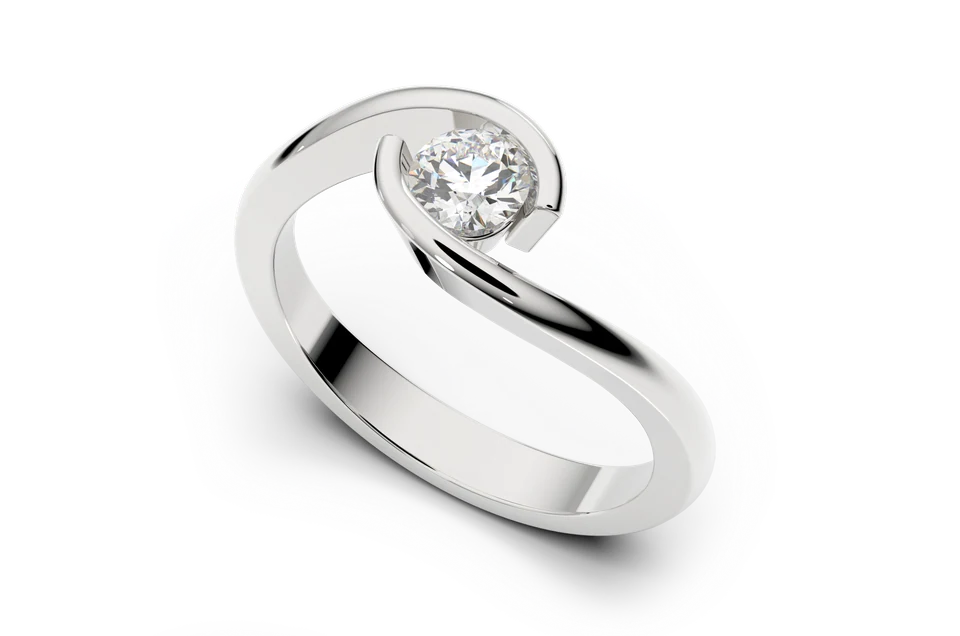
The 4Cs describe colour, clarity, cut and carat weight. Click a value in this fictional example to open its explanation.
A similar appearance does not mean the same material. When selecting an option, we distinguish four possibilities.
A synthetic material resembling diamond. It is neither diamond nor the natural mineral zircon.
A lab-created stone with pronounced flashes of colour. It has its own optical and physical properties.
A diamond grown using technology. It has essentially the same chemical, physical and optical properties as a natural diamond; its origin is different.
A diamond formed by natural geological processes. Its characteristics are assessed on the individual stone.
Diamond grading scales cannot automatically be applied to cubic zirconia or synthetic moissanite.
GIA · Diamonds and their imitations (new tab)
Since 1 October 2025, GIA has used the overall categories Premium and Standard for new assessments of colourless to near-colourless laboratory-grown diamonds. Older reports may use different classifications. Always read the specific document, its date and the issuing laboratory. The scales below primarily explain the traditional GIA report for natural diamonds.
GIA · Updated grading of laboratory-grown diamonds (new tab)
This scale assesses the degree of colourlessness. D is colourless; yellow or brown tones increase towards Z.
The shades in this overview are illustrative only, not colour samples for grading a stone.
| Grade | What it expresses |
|---|---|
| D, E, F | The colourless group. Even here, subtle differences can be distinguished in a laboratory. |
| G, H, I, J | The near-colourless group; perception is affected by size, shape and ambient light. |
| K, L, M | A faintly noticeable colour tint. |
| N, O, P, Q, R | Very light colour. |
| S, T, U, V, W, X, Y, Z | Light colour at the end of the D–Z scale. |
E colour belongs to the colourless group. 'E+' is not a separate GIA grade — the value in the individual stone's report is what matters. A screen cannot replace comparing stones under standard lighting.
Strongly coloured 'Fancy Color' diamonds have a separate grading system. Discover coloured diamonds →
Clarity is assessed at 10× magnification. The size, number, position, nature and contrast of internal and surface characteristics all matter.
| Grade | Meaning at 10× magnification |
|---|---|
| FL · Flawless | A skilled grader observes no inclusions or surface blemishes. |
| IF · Internally Flawless | No observable inclusions; surface characteristics may be present. |
| VVS1 / VVS2 | Very small inclusions that are difficult for a grader to find. |
| VS1 / VS2 | Small inclusions, ranging from difficult to fairly easy to see. |
| SI1 / SI2 | Inclusions are readily visible to the grader. |
| I1 / I2 / I3 | Noticeable inclusions may affect transparency and brilliance. |
Within each group, 1 indicates higher clarity than 2; the I group also includes 3.
Clarity describes what is observed under magnification. Visibility to the naked eye also depends on an inclusion's shape, size and position. When choosing, ask about the specific stone, not just the abbreviation.
Three different aspects of workmanship quality. Oval or round describes a stone's shape; Cut Grade describes the quality of its cut.
Facet proportions and arrangement affect brightness, coloured flashes and the alternation of light and shade as the stone moves.
The quality of facet surfaces. Assessment includes polishing marks, scratches and small surface irregularities.
Geometric precision: symmetry of the outline, the position of the table and culet, and facet alignment.
| Grading | Czech meaning |
|---|---|
| Excellent · EX | Excellent |
| Very Good · VG | Very Good |
| Good · G | Good |
| Fair · F | Fair |
| Poor · P | Faint |
The overall GIA Cut Grade applies to standard round brilliant diamonds in the D–Z colour range. For ovals, pears or emerald cuts, do not interpret Excellent Polish and Excellent Symmetry as an overall cut grade.
'Triple Excellent' means Excellent grades for Cut, Polish and Symmetry. Even so, it is worth seeing the stone in motion.
GIA · Polish, symmetry, culet and girdle (PDF) (new tab)
| Parametr | What you are reading |
|---|---|
| Table % · tabulka | The width of the top table facet relative to the stone's diameter. |
| Depth % · hloubka | Overall height relative to diameter, or usually to width for non-round shapes. |
| Crown / Pavilion · koruna / pavilon | The upper and lower parts of the stone; their angles together affect the movement of light. |
| Girdle · rundista | The edge around the stone. An extremely thin girdle may be more vulnerable to damage; a very thick one may conceal weight. |
| Culet · kaleta | A tiny facet at the bottom point. 'None' means there is no culet. |
Assess proportions together and in relation to the specific shape. One percentage alone does not determine a stone's beauty.
Some diamonds visibly glow under ultraviolet light, most often blue. This is fluorescence; it is not the same as sparkle in ordinary light.
| V reportu | Intensity of the reaction to long-wave UV |
|---|---|
| None | No observable reaction |
| Faint | Weak |
| Medium | Medium |
| Strong | Strong |
| Very Strong | Very strong |
Its effect depends on the individual stone and the UV component of the lighting. Blue fluorescence may lessen the perceived tint of some yellowish diamonds. Some strongly fluorescent stones may look milky, although cloudiness can have other causes too.
Compare transparency in ordinary indoor lighting and daylight. 'None' alone does not guarantee a more beautiful stone.
GIA · What fluorescence means — and what it does not (new tab)
Carats measure weight. Dimensions show how much space the stone actually occupies in the jewellery.
Two diamonds of the same weight may have different dimensions. Shape, depth and cut proportions determine this.
Look for Measurements in the report — dimensions in millimetres. For a round stone, these usually give the minimum and maximum diameter and depth; for other shapes, length, width and depth. With multiple stones, distinguish the weight of the central stone from the total weight of all stones.
Inclusions are internal features of a stone. Blemishes are surface features. The name describes the phenomenon; its significance also depends on position and extent.
A crystal enclosed within a diamond. It may be light or dark.
A very small crystal that resembles a dot at 10× magnification.
An elongated crystalline inclusion resembling a fine needle.
A cluster of fine pinpoint inclusions; when extensive, it may affect transparency.
A fracture, often with a light, feather-like appearance. Its extent and contact with the surface matter when assessing durability.
A group of pinpoint inclusions, clouds or crystals associated with changes in crystal growth.
An indentation open to the surface, for example where part of an inclusion has broken away.
Internal lines or bands caused by irregularities in crystal growth.
A remnant of a rough diamond's original surface extending below the polished surface.
GIA · Inclusion glossary (new tab)
The same inclusion may be less noticeable near an edge than beneath the table. A name such as 'feather' or 'cloud' alone is therefore no reason to accept or reject a stone.
A report links specifications to a particular stone. Check its number, origin and measured values.
GIA · Guide to reading a report (PDF) (new tab)
Verify the report with GIA (new tab)This guide does not assess an individual piece or promise that every stone offered has a GIA report. Available specifications and documentation are listed for the relevant variant.
Send us the designs or specifications you are deciding between. We will review them with you and explain what they mean for your jewellery.
Arrange a consultationAn editorial guide by DeLoire based on the cited Gemological Institute of America materials. Verified in September 2026. The Czech descriptions explain terminology; they are not official GIA translations.
Back to the start ↑