Our customers wear their wedding rings for a lifetime, so choosing them deserves careful thought. Wedding rings are not everyday consumables. You wear them at work, in meetings and on holiday. They stay with you for almost your whole life — provided they are properly constructed and have no internal defects.
How to choose wedding rings: the 7 most common mistakes
Mistake 1 — Choosing without expert personal guidance
Choosing wedding rings is a decision with lasting consequences, so expert guidance matters. A consultation with a goldsmith, designer or knowledgeable jeweller helps you understand differences in materials, construction and the overall design of a ring. Ideally, discuss your choice directly with the maker, who oversees the entire process and can explain the practical implications of each decision.
The market offers many products promoted chiefly on price or marketing. The actual quality of construction and materials is often overlooked — precisely where problems can arise that become apparent only during everyday wear.
Through a conventional sales channel, a client often chooses only from ready-made designs. Information is limited to basic specifications, and selection is guided more by availability than suitability. The effects may only emerge over time — in a ring's durability, wearing comfort or potential for future alterations.
Expert guidance is not about making your choice complicated. It helps avoid decisions that are difficult to put right later.
Over years of making wedding rings, we have often met clients who brought in rings purchased without professional advice. The most common problems are unsuitable construction, too little material or the wrong size.
Mistake No. 2 — Buying for price rather than value
A low price or large discount often means compromises in the ring's construction. Manufacturers seeking to reduce production costs may lower the amount of gold in a piece to levels that are almost unsustainable.
Consequence: repeated repairs or replacement — ultimately increasing the cost.
The right approach:Consider price in the context of longevity and quality, rather than as an isolated number.
In our workshop, we often see that the most expensive ring is not necessarily the best. Conversely, an extremely low price often means savings in places that are not immediately visible — the amount of material used or the ring's construction itself.
Mistake No. 3 — Ignoring construction
A wedding ring's construction is crucial to its longevity: the thickness of the material, gemstone-setting method, strength of individual components and alloys used.
Consequence: cracks, missing gemstones, necessary repairs and deformation after a short period of wear.
The right approach: Ask about construction, not just price and appearance.
Mistake No. 4 — Choosing the wrong material
Material and size are among the most important decisions when choosing wedding rings — and among the most often underestimated.
Material is not just about colour
The choice between yellow, white and rose gold is often reduced to appearance. In reality, each alloy has different properties — hardness, resistance to wear and maintenance requirements.
White gold, for example, is usually rhodium-plated to give it a bright white appearance. This layer gradually wears away during normal use and needs to be renewed over time. This is not a defect but a standard characteristic of the material that is worth understanding.
In terms of mechanical properties, white gold is generally among the harder alloys and therefore resists normal wear well.
Yellow gold has a naturally lasting colour that does not change even after years of wear. Depending on the specific alloy, however, it can be somewhat softer and more susceptible to small signs of use.
Rose gold contains a higher proportion of copper, which affects both its colour and its material properties. Some alloys may in practice be less resistant to wear, which is worth considering particularly for delicate rings or those subject to greater stress.
Consequence: Loss of the original appearance, more substantial servicing, or faster wear.
The right approach:Choose the material according to how the ring will actually be worn and its expected lifespan, not just its colour.
Mistake 5 — Choosing the wrong size
Finger size changes throughout the day with temperature and physical activity. Morning and evening measurements may differ, as may winter and summer measurements. Common mistakes include measuring too quickly without considering these factors, or choosing a tight fit to keep the ring secure. Accurate sizing requires a specialist and professional jeweller's equipment.
Consequence: Discomfort, pressure marks or, conversely, a risk of losing the ring.
The right approach: Measure when at rest, ideally more than once, and consider the ring's width — a wider band fits differently from a narrow one.
Mistake No. 6 — Choosing without checking size and comfort
Choosing online can be convenient and useful for comparing models, variants and prices. It is important to know your correct size and understand the ring's proportions. A photograph alone cannot show how a particular width or profile looks on your hand.
If you are unsure, seek expert advice or try rings in person. At the DeLoire atelier on Kozí in Brno, we will check size, width and wearing comfort with you. Discuss alterations and any personalisation before ordering.
How to find your ring size · Browse wedding rings · Arrange a visit in Brno
Mistake 7 — Overlooking future servicing
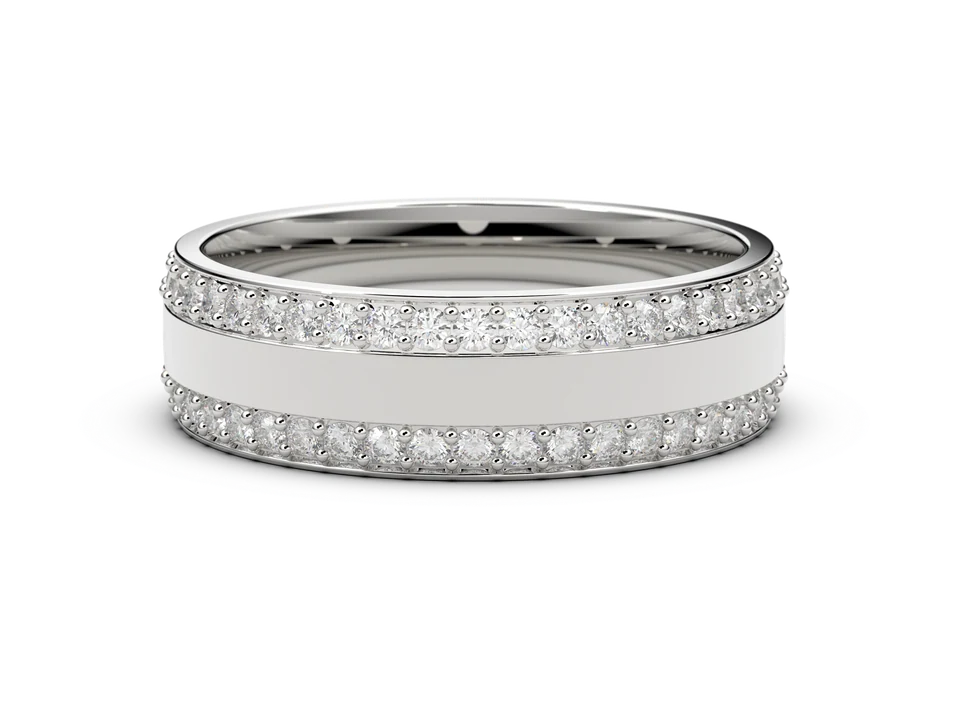
Wedding rings are chosen with the expectation that they will stay the same. In practice, finger size, surface finish and overall wear change. Selection often focuses only on appearance and current size, leaving future alterations and servicing aside, even though some designs severely restrict them or make them impossible. Rings set with stones all the way around and very thin models are typical examples.
Consequence: Difficult or impossible resizing, higher servicing costs, or even the need to make a new ring.
The right approach: Consider from the outset how the ring could be altered in future, and
know the limitations of the specific design.
Behind every wedding ring are hundreds of small decisions that are not immediately visible. The maker's experience determines whether a ring will simply look good on your wedding day or serve you comfortably for decades. At DeLoire, we make wedding rings with an emphasis on construction, materials and lasting durability, because a ring that accompanies you throughout life deserves that same care from the very beginning.
Radim & Michaela